
Paper Club #1: The Tax Benefits of Pre-Tax Alpha
AQR's paper shows that manager alpha compounds into bigger tax benefits (more harvestable losses, more leverage capacity, lower embedded gains), but since leverage amplifies skill in both directions, the practical takeaway is to weigh manager skill alongside tax benefits when picking a tax-managed provider.
Last week, I shared that my team would be digging into various research papers and sharing our thoughts.
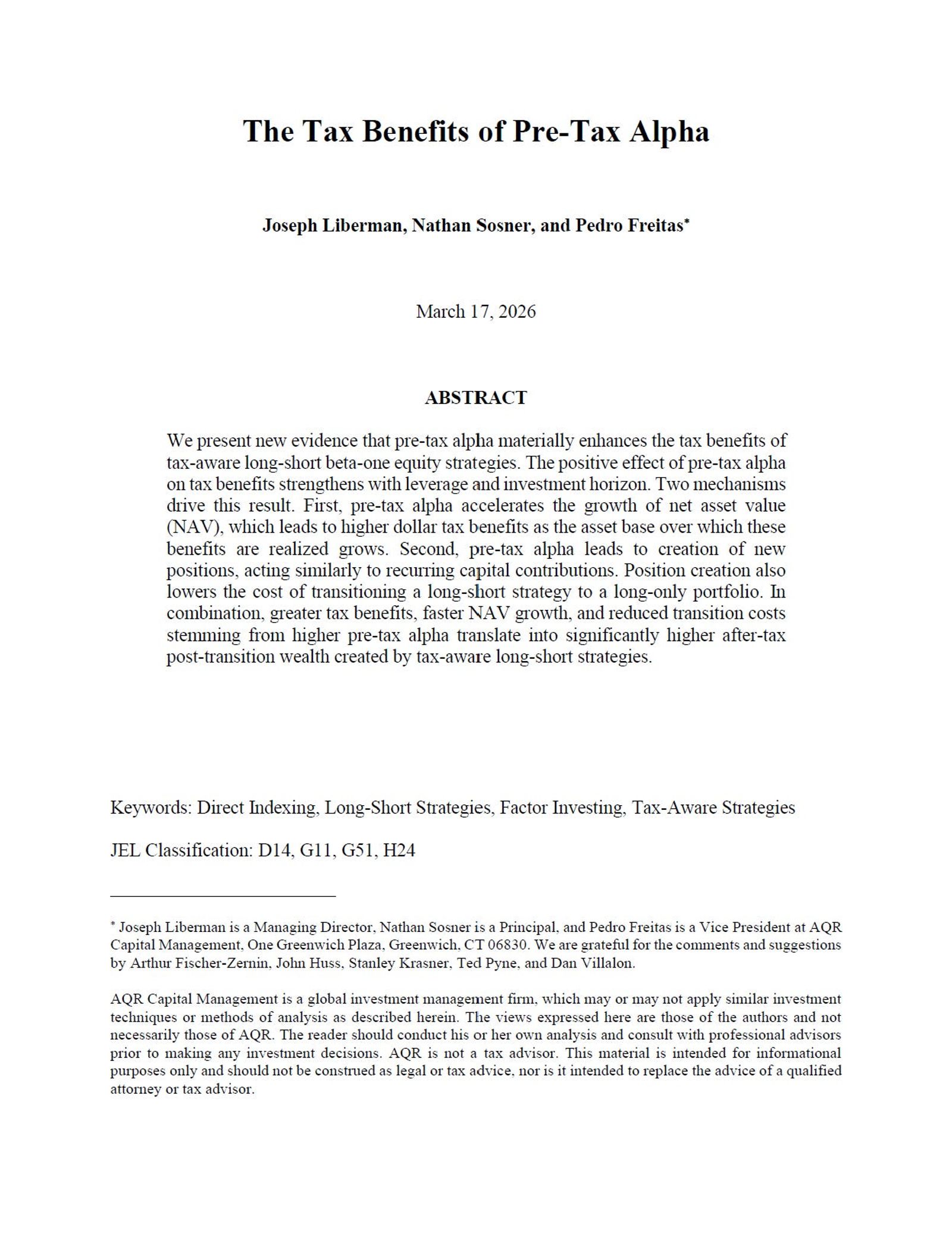
Here is the rundown of our inaugural paper: AQR Capital Management’s newest working paper, “The Tax Benefits of Pre-Tax Alpha,” by Joseph Liberman et al.
TL;DR
- If a manager can pick stocks well, the portfolio appreciates faster.
- With a larger portfolio, you can harvest more losses, your reinvested tax savings compound at a higher rate, and you can continually expand leverage to buy new positions.
- This allows a better stock picker to generate more capital losses and have a lower embedded capital gain as a percent of the portfolio
The team’s thoughts
Managerial skill matters, particularly in long/short. The paper provides a clear view of the benefits of manager alpha: unlocking leverage expansion and delivering pseudo-organic cash flow into the portfolio.
Consistent alpha is hard. The authors back into the amount of alpha based on tracking error and hold it constant across the entire period. This is an interesting way to isolate the effect of alpha, but achieving that level of consistent month-over-month alpha is hard. (The authors acknowledge this, but it’s worth reiterating because it’s a huge driver of the paper’s results.)
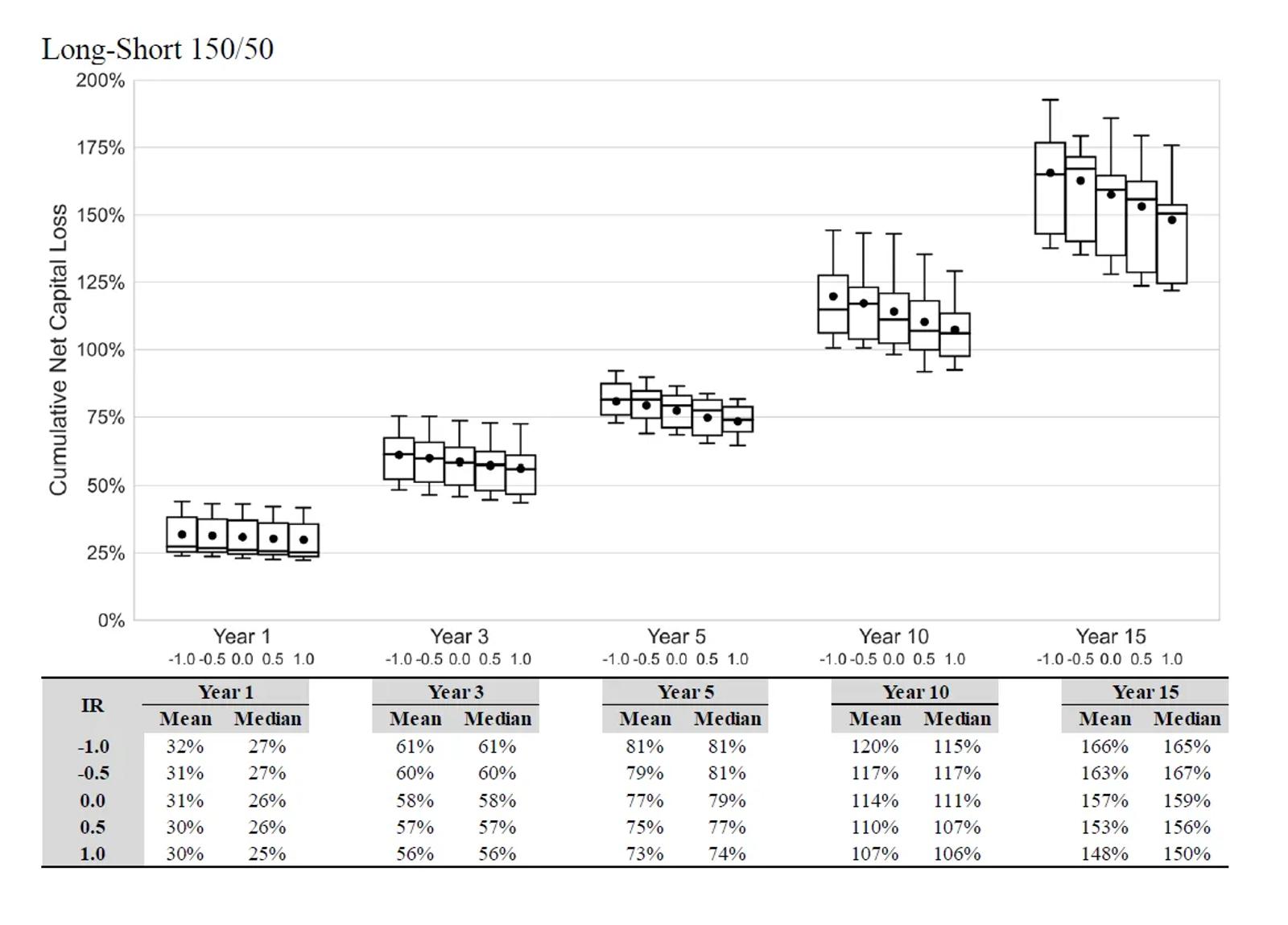
The charts in this paper are brutal. This is a 96-page document, and 61 of those pages are clustered box-and-whisker charts. After the first 10, my head was spinning. This, coupled with the switch from absolute to relative measures and the change in calculation denominators, made it hard to keep things straight. My advice: focus on one set of leverage and/or one time horizon and go from there.
Picture this chart 61 times.
Don’t lose sight of total returns. If you’re going to focus on one set of charts, pay the most attention to Exhibit 7, which shows total portfolio returns after tax. Because the paper’s intent is to study the loss-generating characteristics of long/short portfolios, it’s easy to lose sight of total portfolio returns. Yes, a bad 250/150 manager generates far more capital losses than a good long-only manager, but that manager is also incredibly value-destructive.
Even an average long-only manager beats a bad long/short manager. Another point this paper makes (albeit not as clearly to me as it could) is that leverage amplifies the effect of skill on total portfolio return. In this analysis, an average long-only manager (IR = 0) outperforms a bad long/short manager (IR < 0).
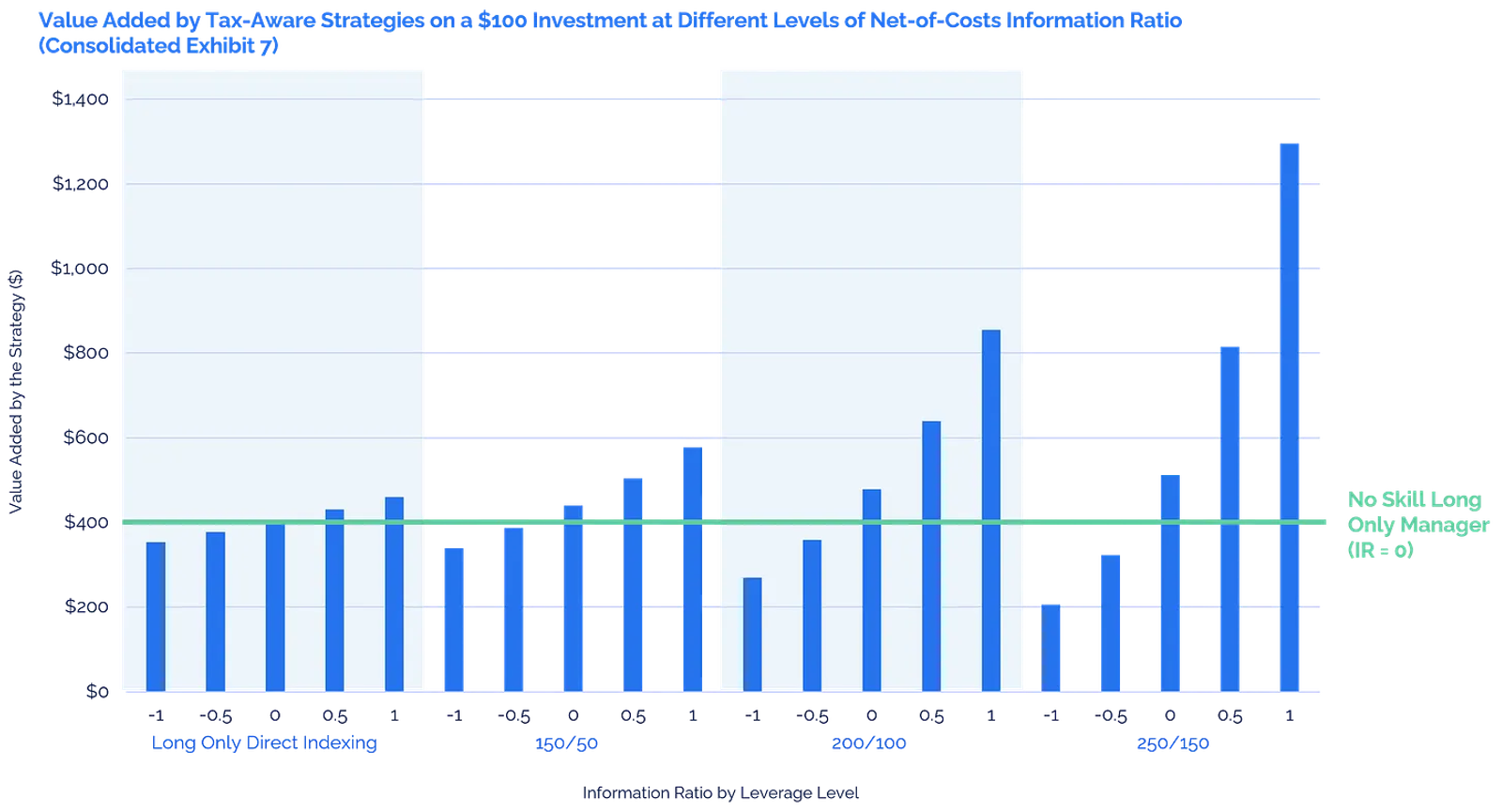
Skill matters in long-only, too. While the effects of manager skill are more pronounced in long/short portfolios, there is still a positive relationship between manager skill and after-tax returns in long-only portfolios.
Closing thoughts
This is a great contribution to the growing body of research on long/short tax-managed portfolios. Our takeaway for practitioners: this paper puts another vote in the column that managerial skill matters when selecting a tax-managed portfolio provider. Focusing exclusively on tax benefits at the expense of the underlying investment strategy could leave opportunity on the table.
Disclosures
All investing is subject to risk, including possible loss of principal.
Quorus Inc. ("Quorus," "we," or "our") is an investment adviser registered with the Securities and Exchange Commission ("SEC"). Registration does not imply a certain level of skill or training.
The material presented is for informational purposes only and should not be construed as investment advice. It is not a recommendation of, or an offer to sell or solicitation of an offer to buy, any particular security, strategy, or investment product. Investing in securities involves risks, including the potential loss of money, and past performance does not guarantee future results. Historical returns, expected returns, and probability projections are provided for informational and illustrative purposes and may not reflect actual future performance. Nothing in these materials should be construed as personalized investment advice, which can only be provided in one-on-one communications.
Tax-loss harvesting and tax-aware management seek to improve after-tax outcomes but do not guarantee any tax result, and their effect depends on a client's individual circumstances, including tax rates, holding periods, and other activity in the client's accounts. Quorus does not provide tax or legal advice. Clients should consult their own tax and legal advisers.
The views expressed are the personal opinions of John Hill, CFA, Co-Founder and President of Quorus Inc., and should not be regarded as the views of Quorus Inc. or as a description of its advisory services.
Discussion of third-party research reflects the authors' reading of that research and is provided for educational purposes. Certain information contained herein has been obtained from third-party sources. While taken from sources believed to be reliable, Quorus has not independently verified such information and makes no representations about its accuracy or its appropriateness for a given situation. Hyperlinks to third-party content are provided for convenience and are not an endorsement of that content.
A copy of Quorus's current Form ADV Parts 2A and 2B, which contain important information about our advisory services, fees, and disciplinary history, is available upon request.